Fink Family Farm Bird List

Fink Family Farm Bird List

News Flash!! October 2025: Just added Farm Bird # 154: a Mountain Quail, hanging out with about 60-70 California Quail. Woohoo!   The only ...

Monday, January 27, 2020

Confusing Juncos


After reading Dave Irons article in Oregon Birds about the various subspecies of Oregon Juncos and then reading a few OBOL posts on one of those subspecies, Pink-sided Juncos, I started looking more carefully at the numerous Juncos that come out to eat the seed I throw for them in front of our barn here in southwest Yamhill County. I had never noticed the diversity in colors. One in particular stood out and I wondered if it could be a Pink-sided. I sent the photo to OBOL and was told:


"Pink-sided have a darker buff color on the sides that comes farther down towards the center of the breast than this bird does. The cane crossing in front of it does block the sides of the bird but up front looks too narrow for Pink-sided.  Pink-sided also are noticeably dark in the lores, between the base of the bill and the eye. There is a darker area but it above the area that would be blacker."
 
 
I took more photos the next day and am amazed at how different are these birds that I had always thought were the same. 


Below is the paler variety. According to Dave Irons article in Oregon Birds, the brown on the head and lighter gray hood is typical of immatures and females. I do not know if this is the same bird I photographed the day before.


Nor do I know if it is the bird below on the old wood planter box. (They appear and disappear quickly.) This bird was very shy and hard to take a photo of.


 Below are some of the black-headed males, which I cannot tell apart. There are lots of them.


Oops! Not a junco. A Brush Rabbit, which are common around here.

Don't know if this light-headed junco is the same or a different one.

 And here's a mystery junco in the underbrush, with a hood apparently more brown than black.

 
The only non-Oregon junco I can tell for sure is the Slate-colored, which we have had here on our farm in the past.


Who knew Dark-eyed Juncos were so diverse! I'll be more observant now, thanks to Dave Irons' article.

Saturday, November 16, 2019

Lesser Goldfinches


American Goldfinches are common here on our farm in the summer but seldom seen in the winter.  I've sworn I've never seen Lesser Goldfinches here. Dawn V., however, took a photo of a male Lesser here so there was one but I never saw it.

Today, November 16, 2019,  a whole flock of what I think are Lesser Goldfinches spent a lot of time feeding in the birch tree right outside our back door. I took a zillion photos. Will revise this post if anyone explains why I'm wrong.


Wednesday, November 13, 2019

First Raptor Run of 2019/2020


The kites are back! Not everywhere, but in 3 of the sites where we used to see them. We saw a total of 5 kites today, three of them flying about together in one area. The only place I got a photo, of one kite, the landowner said there were usually two kites. Maybe they'll stick around and nest! It was a long look to this kite so my photos are blurry. (that's my excuse.)


More excitement came from a tip from a friend: an eagle nest we did not know about on our route. An eagle was stationed by the nest today.


Farther along on our route in the Sheridan area, there is a small dug "fire" pond. Today a Black Phoebe was hanging out nearby, preening.


It was a beautiful day for a drive but we were still under the weather from the colds we are recovering from. The kites and eagle nest and phoebe were great spirit lifters.


Thursday, November 7, 2019

Yellow-bellied Sapsucker is back!

Lousy photos but if you see all of them you can put the bird together. He (for it appears to be a male since it has a red throat), and yellow-bellied because no red on nape and the red on throat has a complete black border. That's my story and I'm sticking to it. (11/7/19)


And on 11/17/19 it returned but very camera shy.


Sunday, April 21, 2019

Warbler but which one?


For those who like photos of just a piece of a bird to try to figure out what it is, this photo is for you. Lots of warblers in our cherry tree this Easter day, mostly Orange-crowned, but this looks different. Very yellow below is all I'm sure of. Any keys, comments, ideas, suggestions would be much appreciated. Thanks!


Even closer (and blurrier)...


Monday, February 11, 2019

Sapsucker... Red-naped or Yellow-bellied


A sapsucker has been mewing on our farm for months. I have not been able to get good photos yet. Listers who have been here insist it is a Yellow-bellied. But Yellow-bellied Sapsuckers do not get adult plumage, according to Sibley, until March. This bird now has a red forehead and red throat. I will post the first blurry photos from January 28, 2019. Clearly a juvenile. It appeared to have, in my brief previous glimpses, a yellowish belly.


 But in this 1//28/19 photo, it appears to have a bit of red at the throat and possibly on top of the head. Possibly. Lousy photo.


I assumed I was seeing the same bird on Feb.4 when I took these blurry photos. If the same bird, it had changed a lot in 6 days. gone is the brownish upper chest. Now it clearly has a red forehead and at least partial red throat.


That same day, two listers came out and caught brief glimpses, declaring it a Yellow-bellied because it was still in juvenile plumage this time of year. The bird then disappeared until Feb. 10. Another lister came out, caught a brief glance, and agreed with the first two listers.

I don't know if the bird of Jan. 28 is the same as the bird of Feb. 4 and 10. I don't know if the bird of Feb. 4 could be considered in "juvenile plumage".

Any help by anyone knowing about plumage changes in sapsuckers would be most appreciated.

I am not inviting birders out to view it for a time as it seems shy and easily scared off. I would like it to stick around.

Thanks to Dave Irons for his reply:


On 2/11/2019 4:05 PM, David Irons wrote:
Looks like a fair amount of juvenile plumage retained, which makes this a Yellow-bellied Sapsucker rather than one of the other two species. Everything that I can see from the better photos suggests Yellow-bellied. I see no red on the nape.
Dave Irons
Beaverton, OR
 
and...
 
A first-winter Yellow-bellied Sapsucker could well be molting right now. They usually most late winter/early spring and will look like adults by March or so.

Dave 

On 2/15/19, the bird returned and mewed all morning from trees next to our house. I took these photos:


Sunday, January 20, 2019

Snow Geese


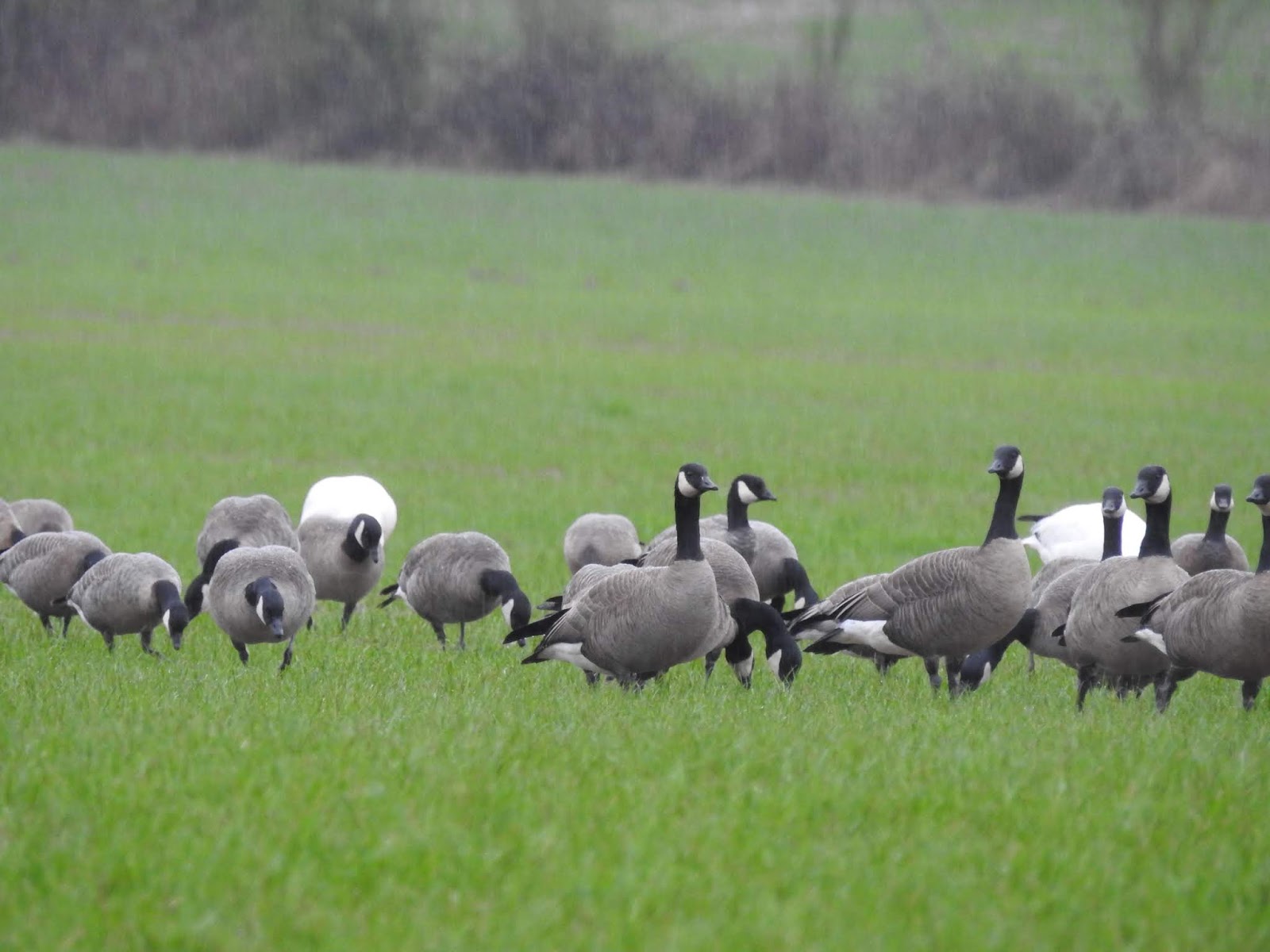
Johnny called on his way to church this morning to tell me that there were 2 white geese with the Canada's in the green field one mile from here, so I drove down and took photos before milking goats.

The geese were way off in the field with the two white ones behind them, eating and seldom lifting their heads. They were not very cooperative for photos but I did get distant shots of one of them up at a time. I think the other geese are Cacklers as they seem to have a purplish sheen to their breasts and are smaller than the Snows.


I called Paul Sullivan while I was looking at them and he came out and checked off his first Yamhill County Snow Geese of 2019. I wish they would come land in one of our fields so I could add them to my farm list.