Fink Family Farm Bird List

Fink Family Farm Bird List

News Flash!! October 2025: Just added Farm Bird # 154: a Mountain Quail, hanging out with about 60-70 California Quail. Woohoo!   The only ...

Friday, October 25, 2013

A Bird Out Of Place

Coots are common in inland waterways around me. I know what they look like on land and water. They are, according to The Sibley Guide to Birds, gregarious and dive for aquatic plants in marshy wetlands.

Therefore, a small bird hiding behind a rock at the base of a waterfall at the coast with nothing but a wide rocky beach in one direction and a steep cliff in the other, no other birds in sight but gulls, could not be a coot. Or so I decided. But I was wrong. I don't know why it was where it was, all by itself, but there it was. Another birding lesson learned. A coot is a coot wherever it is.


American Coot

Thursday, October 24, 2013

From Baskett Slough to Sheridan

As usual, my trip to the feed store took a few detours... Most of the photos did not come out great, but, oh well. I like the cormorant. Friend Dawn rode with me and hopefully got better photos.

From Baskett Slough...

Adult Bald Eagle
Juvenile Red-tailed Hawk


to Livermore Road... 

Ring-necked Pheasant without the ring. I've read that cocks don't develop the white ring until they are 18 weeks old

And up Tucker Rd. ...


Female Kingfisher
We saw flocks of Pipits popping up and down out of a plowed field on Livermore, but this Pipit was all by itself on a power line along Tucker Rd.

American Pipit

At the slough on Ballston Rd. as you head toward the Sheridan Fishing Pond (and sewage ponds), we saw four Snipe. They were well camouflaged.


Common Snipe


Same bird as above, but zoomed in closer


Common Snipe above and below the water

Also above and below water was this Double-crested (double headed?) Cormorant

Double-crested Cormorant

 In the bushes between the fishing pond and the sewage ponds were Red-winged Blackbirds among other (not photographed) birds. In the ponds were gazillions of Ruddy Ducks (mostly sleeping) and Northern Shovelers (mostly with their heads under water),  skittish Ring-necked Ducks and lots of others too far for pictures (although I tried).

Red-winged Blackbird
I missed photos of Western Meadowlarks on Livermore Rd. They ducked down every time I finally had them in the viewfinder. Dawn did better. But I was sorry I couldn't find her a Horned Lark along Livermore where I usually see them. Maybe next time... I'll need feed again in another couple of weeks...


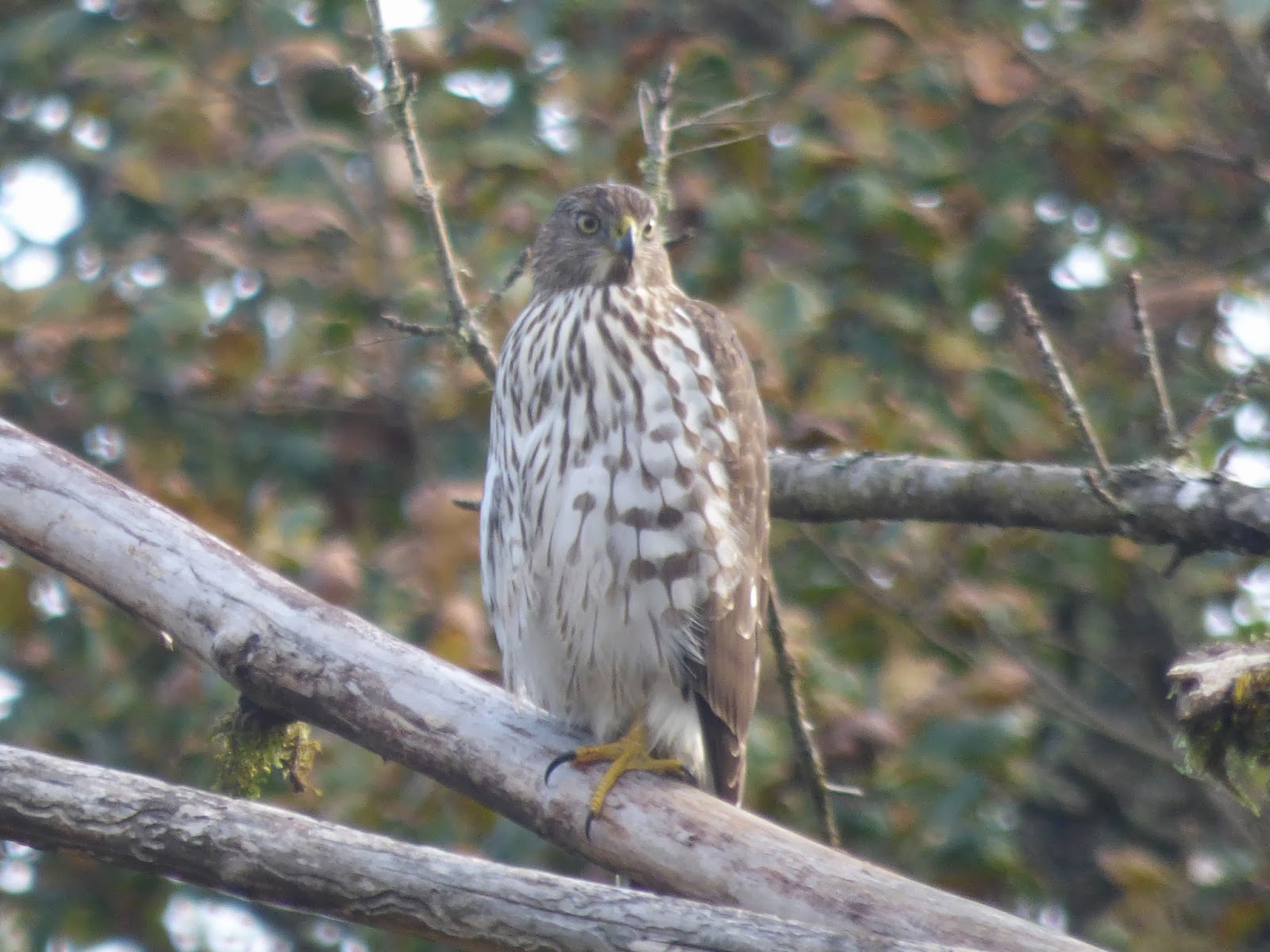
Juvenile Cooper's Hawk

Fluffed up and patiently waiting for the quail/sparrows/towhees/jays/doves to venture into view again in front of the barn, where I had thrown seed for them... (I couldn't decide which photo to use...)


Friend Dawn Villaescusa had been watching the Cooper's in front of our barn before I joined her. She got some awesome photos of the hawk from the back before he turned around. I stole one of them. Thanks, Dawn!


The next morning this was the scene that greeted me when I tossed grain out for the birds again.


In spite of the apparent bluish cast to the feather below (an artifact of lighting, I guess), it was actually gray, black and white. This Fish & Wildlife Service web site identified it as a Mourning Dove feather.  http://www.fws.gov/lab/featheratlas/feather.php?Bird=MODO_tail_imm


We now have one fewer Mourning Doves in the neighborhood. And a juvenile Cooper's Hawk with a full belly, at least on that day.


Thursday, October 3, 2013

Arctic Loon?? Nope. Common Murre

It seems everyone except me knew that this colorful bird was a winter plumaged Common Murre. It looks nothing like the penguin look-alikes I see in the summer massed atop rocks. But I will forever now recognize it ... (hopefully)

Below was written B.E. (Before Enlightenment)

Help! This bird was swimming with surfers today at Cape Kiwanda. Very colorful, whatever it is.


You can see how close it was to the surfers here. Almost seemed to be deliberately swimming toward and near them.


Here it is blown up (and blurry).

It looks like a loon to me and with all that white on the flanks, an Arctic Loon. But is all the other white here and there because it's in the middle of a molt? Or is it something else?

Tuesday, September 24, 2013

Turkey Vultures


Turkey Vultures are gathering to leave for southern climes. Twenty-four of them landed on our tall snag this morning to rest before moving on, hopefully ahead of the rain that soon followed.


They took turns spreading their wings and drying out for the long journey ahead of them. Safe travels, my friends! I'll look forward to seeing you next spring.


Monday, August 19, 2013

More Birds from Japan

Here are the rest of the photos my Japanese birder contact, Isao Saitou, took and sent to me. The first bird, Long-eared Owl, is the only one also present in Oregon. However, the Orange-flanked Bush-robin has been popping up all over the world lately, including western Alaska. http://www.theguardian.com/science/grrlscientist/2012/mar/10/2   Who knows where it will appear next?


Asio otus, Long-eared Owl

Asio otus, Long-eared Owl

Aegithalos caudatus, Long-tailed Tit

Long-tailed Tit


Buteo buteo, Common Buzzard


Haliacetus pelagicus, Steller's Sea Eagle


Cyanoptila cyanomelana, Blue-and-white Flycatcher


Cettia diphone, Japanese Bush Warbler


Erithacus akahige, Japanese Robin or Komadori


Tarsiger cyanurus, Orange-flanked Bush-robin


Pyrrhula pyrrhula, Eurasian Bullfinch


Ruddy Kingfisher, Halcyon coromanda

Crested Serpent Eagle, Spilornis cheela


Haliaeetus albicilla, White-tailed Eagle


White-tailed Eagle

Sunday, August 18, 2013

Japanese Crested Ibis


No, I haven't been to Japan. Rather, my Japanese sister, Yoko, along with her daughter Maki and family, visited us last week. Yoko has a friend in Japan, Isao Saitou, who is an ardent birder. He sent along a little thingie to plug into the computer (I have no clue what those thingies are called) with photos he has taken of Japanese birds and asked that I put photos of Great Egrets on it for him. Fortunately, Steve and family were here at the same time and Steve did the honors for me. I uploaded all the decent bird photos I've taken that I could find. But I had nothing to compare to his Toki, or Japanese Crested Ibis.

Here is what Wikipedia says about this extremely rare bird:

At one time, the Crested Ibis was widespread in Japan, China, Korea, Taiwan, and Russia. It has now disappeared from most of its former range. The last wild Crested Ibis in Japan died in October 2003, with the remaining wild population found only in Shaanxi province of China until reintroduction of captive bred birds back into Japan in 2008. They were previously thought to be extinct in China too, until 1981 when only seven ibises were seen in Shaanxi, China.

On September 25, 2008, the Sado Japanese Crested Ibis Preservation Center released 10 of the birds as part of its Crested Ibis restoration program, which aims to introduce 60 ibises into the wild by 2015. This marks the first time the rare bird has returned to the Japanese wild since 1981.[3]

On April 23, 2012, it was confirmed that three crested ibis chicks had hatched on Sado Island in Niigata Prefecture, the first time chicks had hatched in the wild in Japan in 36 years.[4] One of the chicks briefly left its nest on 25 May.[5]


These photos were all taken in Niigata Prefecture by Isao Saitou. Many thanks to him for these amazing photos of an extremely rare bird.